



How Commercial Painting Fanatics Preps Every Single Wall
TL;DR Commercial painting covers offices, warehouses, and retail buildings, using materials and crews suited to that scale rather than a residential setup. The step that actually determines how long a paint job lasts is surface prep, not the paint itself. Commercial Painting Fanatics handles the full process — prep, coating, scheduling around business hours — and coating choice should always match what the surface will be exposed to. Before hiring anyone, check insurance, ask for references from similarly sized jobs, and get a walkthrough quote instead of a number over the phone.
Most people don’t think about the paint on a building until it’s peeling. By then the fix usually costs more than it would have a year earlier, and the property owner is stuck choosing between a rushed patch job or a full repaint they weren’t budgeting for. Commercial Painting Fanatics gets called into a lot of these situations — offices, warehouses, strip malls, the occasional apartment complex — and the pattern is almost always the same: somebody hired the cheapest bid, the prep work got skipped, and the paint failed in under three years instead of lasting seven or eight.
Quick Answer: Commercial painting means coating business properties — offices, warehouses, retail buildings — with materials and crews built for that scale, not the residential setup. Commercial Painting Fanatics handles the whole job: prep, coating, scheduling around business hours, and the inspection at the end. The difference between a job that lasts a decade and one that peels in two years almost always comes down to how much time went into prep before a single coat went on.
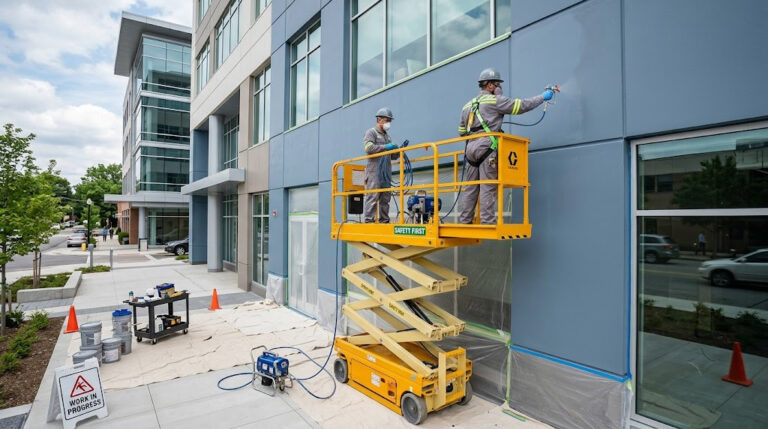
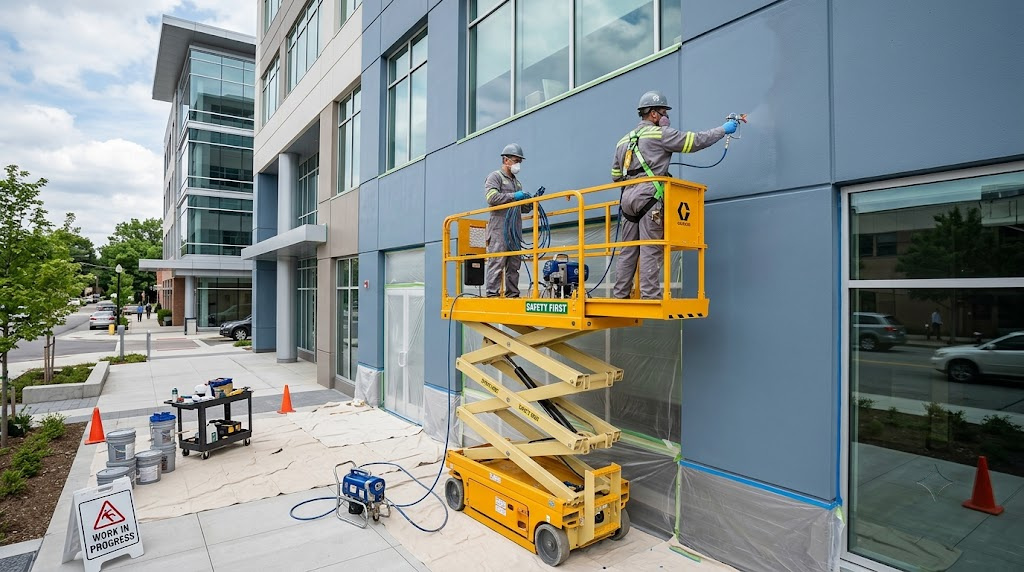
Commercial painting is the professional coating of business, industrial, or institutional properties, using materials rated for higher traffic and stricter conditions than a typical house paint job. It’s not just “painting but bigger.” Crews need to work around occupied buildings, meet code requirements like OSHA safety standards and VOC limits, and use equipment — lifts, industrial sprayers, containment barriers — that a two-person residential crew simply doesn’t carry.
Why This Matters More Than Owners Think
A building’s exterior does a lot of silent talking. Faded signage, chalky stucco, a lobby that hasn’t been touched since the building opened — none of it says anything a manager wants a client walking in to notice. That part’s obvious enough that most people already get it.
What gets missed is the protective side. Paint isn’t decoration sitting on top of a wall — on an exterior it’s the layer standing between stucco or siding and years of UV exposure, rain, and temperature swings. Inside a warehouse, a good epoxy coating is what keeps a concrete floor from pitting under forklift traffic. Skip maintenance long enough and you’re not repainting anymore, you’re doing structural repair with paint as an afterthought.
What Commercial Painting Fanatics Actually Does
The services break down roughly like this:
- Exterior painting for retail fronts, office buildings, and multi-family properties
- Interior work — lobbies, hallways, break rooms, the kind of spaces that take daily wear
- Warehouse and industrial coatings, epoxy floors being the most requested
- Line striping for parking lots and warehouse floor markings
- Pressure washing and prep, which honestly should be listed first, not last
- Color consultation for owners who want something that matches signage or branding
- Ongoing maintenance contracts for properties that would rather budget small and often than large and rarely
Most jobs happen in phases, often after hours or over a weekend, so a retail store or office doesn’t have to shut down while walls dry.
Commercial Painting vs Residential Painting
| Factor | Commercial | Residential |
|---|---|---|
| Scale | Multi-story, large square footage | Single-family scale |
| Scheduling | Phased, often after hours | Flexible daytime work |
| Materials | Industrial-grade, code-compliant | Standard interior/exterior paint |
| Equipment | Lifts, sprayers, scaffolding | Ladders and brushes |
| Compliance | OSHA, fire code, VOC limits | Minimal regulation |
| Crew size | Larger teams, faster turnaround | One to three painters |
| Insurance | High liability coverage required | Standard contractor policy |
A residential painter taking on a commercial job usually isn’t doing anything wrong on purpose — they just don’t have the crew size or equipment to hit commercial timelines, and coatings meant for a house don’t hold up the same way under warehouse traffic or constant sun exposure on a flat commercial roofline.
What A Job Actually Looks Like, Step By Step
It starts with a walkthrough, not a phone quote. Anyone giving a firm number without seeing the building is guessing, and that guess tends to get expensive later.
After that:
- Surface prep — pressure washing, scraping old paint, patching cracks, priming bare spots. This is where most of the labor time actually goes.
- Containment — masking, drop cloths, plastic barriers if the building is occupied during work.
- Application — spray for large flat surfaces, roll or brush for detail work and edges.
- Inspection — checking coverage under different lighting, since a coat that looks even under fluorescent light can show gaps in daylight.
- Walkthrough and sign-off with the client, plus whatever warranty paperwork applies.
Step one is the one contractors cut when they’re racing to underbid someone else. It’s also the reason a “cheap” paint job from three years ago is peeling now.
Picking The Right Coating
There’s no single best paint — it depends on what the surface has to survive.
Acrylic exterior coatings flex with temperature changes and hold up well on stucco and siding. Epoxy is the standard for warehouse floors because it shrugs off chemical spills and heavy equipment traffic. Elastomeric coatings are worth considering on older masonry buildings with hairline cracking, since they bridge small gaps instead of just sitting on top of them. Interior office spaces generally call for low-VOC paint, partly for air quality and partly because a lot of local codes now require it in occupied buildings.
A contractor who suggests a coating without asking what the surface is exposed to day-to-day is guessing too.
What It Costs, Roughly
Pricing runs per square foot, and it swings more than people expect based on surface condition and how hard the building is to access.
| Project Type | Rough Range Per Sq Ft |
|---|---|
| Interior office space | $1.50 to $3.50 |
| Exterior stucco or siding | $2 to $5 |
| Warehouse epoxy flooring | $3 to $7 |
| High-rise exterior with lift access | $4 to $8, sometimes more |
These are ballpark figures, not a quote — a building with peeling lead paint underneath, or one that needs a boom lift because there’s no ground access on one side, can push well past these ranges. Get a walkthrough quote before assuming a number from a range like this applies to your building specifically.
What People Get Wrong Before They Call
A few things come up over and over in conversations with property owners and in facility-manager forums:
The assumption that any painter can handle a commercial job. Licensing, insurance limits, and crew capacity aren’t the same across residential and commercial contractors, and that gap shows up fast on a large job.
The idea that cheaper paint saves money. It doesn’t, usually. A budget coating might need reapplication in two or three years where a commercial-grade product holds for seven to ten.
The belief that painting can happen whenever. Temperature and humidity affect cure time more than most people realize, especially on exterior jobs — a coat applied in the wrong conditions can fail even if everything else about the job was done right.
Mistakes That Show Up In Every Bad Hire
- Not checking that the contractor carries commercial liability insurance and bonding
- Taking the lowest bid without reading what’s actually included — prep work gets excluded from a lot of “budget” quotes
- Skipping the warranty question entirely
- Reading reviews for residential jobs when hiring for a commercial one, which isn’t really an apples-to-apples comparison
- Not asking how big the crew is or what the realistic timeline looks like
What Facility Managers Who’ve Been Burned Recommend
Ask for an itemized quote, not a lump sum. Ask for references from jobs closer to your building’s size, not just any past client. Confirm the coatings meet local VOC and fire code requirements before signing anything. Schedule around downtime instead of trying to force a repaint into a busy season. And if the building needs work every few years anyway, a standing maintenance schedule usually costs less over time than waiting for things to get bad enough to notice.
People Also Ask
How often should a commercial building be repainted? Exteriors typically go five to ten years between full repaints, depending on climate. High-traffic interior spaces like lobbies often need touch-ups every two to three years just from daily wear.
Do commercial painters work outside business hours? Yes, usually. Most commercial contractors, Commercial Painting Fanatics included, schedule around evenings, weekends, or phased sections so the building stays open.
What’s the difference between commercial and industrial painting? Commercial covers offices, retail, and multi-family buildings. Industrial usually means manufacturing plants or warehouses that need chemical- or abrasion-resistant coatings, which is a different set of products entirely.
Is low-VOC paint actually necessary for office buildings? It’s recommended and, in a lot of jurisdictions, required by code for occupied interior spaces. It matters more for air quality during and right after application than most people assume.
How long does a commercial painting project take? Depends on square footage and access, but a mid-sized office in the 10,000 to 20,000 square foot range usually runs one to three weeks including prep and inspection.
FAQ
What does a commercial painting company actually do day to day?
Mostly prep work, if we’re being honest about where the hours go. A crew shows up, assesses the surface, does whatever scraping, patching, or pressure washing the walls need, and only then starts applying coating. The painting itself often takes less time than getting the surface ready for it. For offices, warehouses, or retail spaces, that also means working around a schedule that doesn’t shut the business down.
Why does commercial painting cost more than a house paint job?
Bigger surface area is part of it, but it’s also the equipment — lifts and industrial sprayers aren’t cheap to run — and the insurance requirements are higher because the liability is higher. A crew painting a three-story office building carries more risk than one painting a single-family home, and that gets reflected in the bid.
Can a business stay open while it’s getting painted?
Usually, yes. Contractors who do this regularly know how to section off work areas, use low-odor coatings, and schedule around the hours a business actually needs the space. It’s not always seamless, but it’s manageable.
What’s the go-to coating for warehouse floors?
Epoxy, most of the time. It handles chemical spills and forklift traffic better than almost anything else. Some facilities go with polyaspartic coatings instead when they need faster cure times and can’t afford to have the floor out of commission for long.
How do you tell if a contractor is actually qualified for commercial work, not just residential?
Ask about commercial liability insurance and bonding first. Then ask for references from jobs similar in size to yours — not just any client they’ve had. A contractor who can walk you through their prep process without being asked twice is usually a good sign.
Is a recurring maintenance schedule worth it, or is that just upselling?
It’s usually worth it. Catching a wall before the coating fully fails means less prep work and a smaller bill than waiting until cracks or peeling force a full repaint. It’s the same logic as changing oil on schedule instead of waiting for the engine to tell you something’s wrong.
Key Takeaways
- Commercial painting isn’t just residential painting at a bigger scale — different materials, crew sizes, and code requirements apply
- Surface prep is where most of the labor goes, and it’s the step budget contractors skip
- Coating choice should match what the surface is actually exposed to, not just the lowest price
- Check insurance, bonding, and warranty terms before signing anything
- A standing maintenance schedule usually beats waiting for visible damage
Paint on a commercial building is doing more work than it looks like from the sidewalk. It’s protecting stucco from UV damage, keeping a warehouse floor from pitting under equipment traffic, and, not incidentally, telling customers something about how the business inside is run. The jobs that fail early almost always trace back to the same cause — prep work that got skipped to hit a lower bid. Commercial Painting Fanatics builds scheduling and crew size around actual commercial timelines, which is the difference between a repaint that lasts a decade and one that needs redoing in two years.